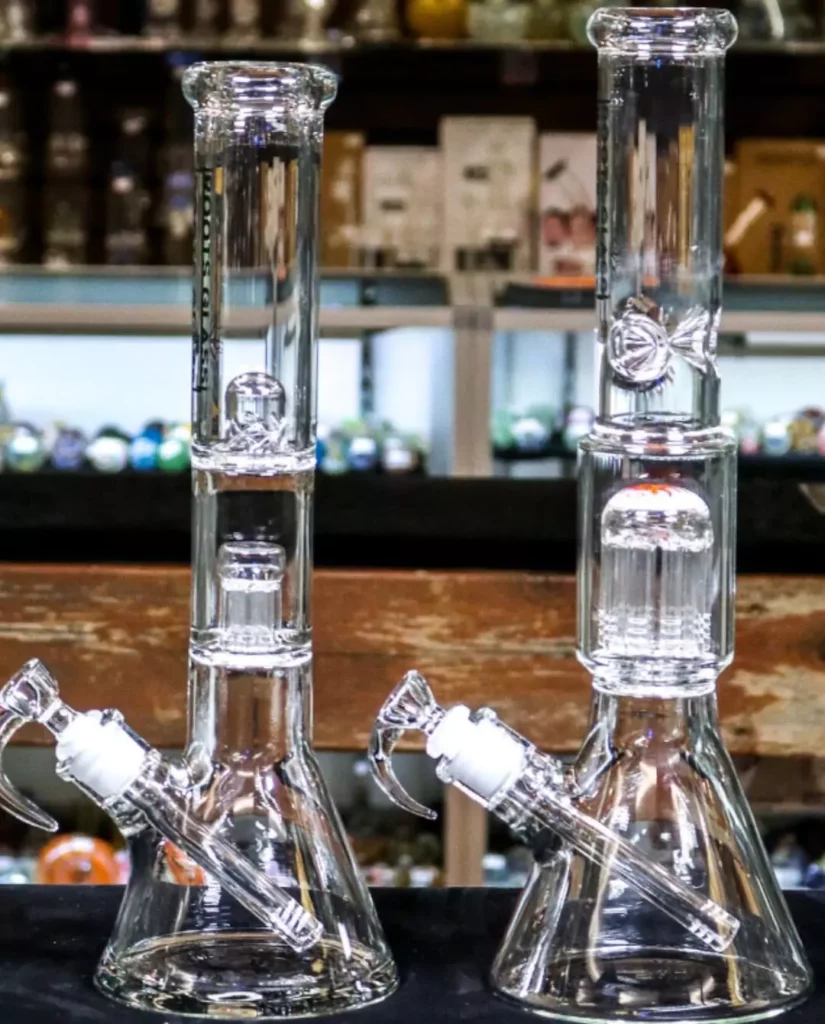
An ash catcher is one of those accessories that seems simple until you go to buy one. Then you’re looking at 14mm vs 18mm, 45 degree vs 90 degree, wet vs dry, honeycomb vs tree perc — and what should have been a quick decision turns into a 20-minute research session.
This guide cuts through all of it. We’ll cover how ash catchers work, how to find the right size and angle for your bong, the difference between wet and dry setups, and which perc type actually makes sense for the way you smoke.
Roots has two ash catcher posts already — one on how to choose the right size ash catcher and one rounding up our top-rated ash catchers. This guide ties it all together.
What does an ash catcher do?
An ash catcher attaches to your bong’s joint and acts as a pre-chamber. Your bowl slides into the ash catcher instead of directly into the bong. When you pull, smoke travels through the ash catcher first, dropping ash, resin, and debris before the smoke ever hits your main water chamber.
The result: your bong water stays cleaner longer. You’re cleaning the ash catcher instead of dealing with gunked-up bong water every session.
If the ash catcher has a percolator, it also filters and cools smoke on the way through. Cleaner hit, lower temperature, less harshness.
That’s the whole concept. Simple in theory. The tricky part is buying the right one.
Which is better, a 45 degree or 90 degree ash catcher?
This is the most common mistake. Get the wrong angle and the ash catcher physically won’t sit flat on your bong — it’ll tilt awkwardly or point straight down into the water. Either way, it doesn’t work.
45 degree ash catchers are designed for bongs with angled joints — this is most beaker bongs. The joint on a beaker typically angles outward at roughly 45 degrees from vertical.
90 degree ash catchers are designed for straight tube bongs. The joint on a straight tube usually sits more vertically.

How to tell which angle your bong needs
Look at the joint on your bong. If it angles outward diagonally — like pointing toward 10 or 11 o’clock — that’s a 45 degree joint. Get a 45 degree ash catcher.
If the joint points more vertically or straight out horizontally — 12 o’clock or closer to 9 o’clock — that’s a 90 degree joint. Get a 90 degree ash catcher.
When in doubt: most beakers take 45 degree. Most straight tubes take 90 degree. If you have a beaker and you’re not sure, buy the 45.
The way to double-check once it arrives: attach the ash catcher and fill the chamber with water. The water level should sit flat and even. If it’s spilling out the side or sitting at a weird angle, you’ve got the wrong degree.
What size ash catcher do you need: 14mm or 18mm?
Your ash catcher’s joint size has to match your bong’s joint size exactly. A 14mm ash catcher goes on a 14mm bong. An 18mm ash catcher goes on an 18mm bong. That’s non-negotiable — they won’t fit otherwise.
14mm is more common. Most mid-size bongs, mini rigs, and daily drivers run 14mm joints. 18mm joints show up on larger bongs built for bigger hits.
How to measure your bong joint
A 14mm joint is roughly the same diameter as a standard pencil eraser. An 18mm joint is about the size of a marker cap. Use a ruler or calipers to measure the inside diameter of the female joint. Check your bong’s product page too — joint size is almost always in the specs.
For the full breakdown on joint gender (male vs female) and adapters, see our ash catcher size guide.
Should you get a wet or dry ash catcher?
This is a real trade-off. It’s not just about filtration — it’s about weight, drag, and how much maintenance you want to deal with.
When to use a wet ash catcher
Wet ash catchers hold water and usually include a percolator. Smoke passes through the water and perc before reaching your bong, adding filtration and cooling on top of whatever your bong already does. If you like smooth, cooled-down hits and don’t mind the extra upkeep, a wet ash catcher is the move.
The downsides are real too. Wet ash catchers add drag, add weight on the joint, and you need to change the water after every session or it gets foul fast.
When to use a dry ash catcher
Dry ash catchers trap debris without water — just a collection area where ash and particulates settle before reaching your bong. No added drag. Much lighter. Easier to clean. For smaller bongs, mini rigs, or anyone who values flavor — dry is usually the better call.
Which ash catcher perc type is best?
If you’re going with a wet ash catcher, the perc inside affects how it hits.

Honeycomb perc
A flat disc with dozens of small holes. Smoke gets pushed through and broken into fine bubbles, maximizing contact with water. Consistent, easy to pull through, good all-around choice.
Tree perc
Multiple vertical arms with slits at the bottom. Effective but adds more drag than a honeycomb and the arms are more fragile. For an ash catcher going on and off regularly, honeycomb is more practical.
Showerhead perc
A tube that flares into a cone-shaped diffuser with slits around the perimeter. Good diffusion, moderate drag, compact design that fits well in an ash catcher body.
No perc (dry)
Some ash catchers have just a water chamber with no perc — lower drag, simpler to clean, still adds some cooling. A middle ground between fully dry and a percolated setup.
Recommended products


How do you use an ash catcher?
Attach the ash catcher to your bong’s joint — same way your bowl attaches. Your bowl then slides into the ash catcher’s joint. If it’s dry, you’re done. If it’s wet, add water before use.
How much water goes in an ash catcher?
Add just enough water to cover the perc slits or holes by about 2-3mm. More water means more drag and a higher risk of splash. Less water means the perc doesn’t work properly. Start small, take a test pull, and adjust.
How do you clean an ash catcher?
Dry ash catchers: Empty debris after each session. Rinse with hot water weekly. For buildup, soak in 90%+ isopropyl alcohol and rinse clean.
Wet ash catchers: Change the water after every session. For deep cleaning, shake with isopropyl alcohol and coarse salt, then rinse thoroughly with hot water until no alcohol smell remains.
If you want specific picks, check out our roundup of the ash catcher picks — broken down by size, angle, and setup type.
Frequently Asked Questions
What does an ash catcher do?
An ash catcher sits between your bowl and your bong and intercepts ash, resin, and debris before it hits your main water chamber. It keeps your bong water cleaner longer. If it has a percolator, it also adds extra filtration and cooling before smoke reaches your bong.
45 degree vs 90 degree ash catcher — which do I need?
Most beaker bongs take a 45 degree ash catcher. Most straight tube bongs take a 90 degree ash catcher. Look at the joint on your bong: if it angles diagonally outward, get a 45 degree. If it points straight up or out horizontally, get 90 degree. Using the wrong angle means the ash catcher will tilt or droop instead of sitting flat.
Do I need water in my ash catcher?
Only if it has a percolator. Wet ash catchers need water to cover the perc slits by about 2–3mm. Dry ash catchers work without water — they trap debris without a water stage. If yours is a dry catcher, leave it empty.
Does an ash catcher make hits smoother?
A wet ash catcher with a percolator adds filtration and cooling, which softens the hit. A dry ash catcher won’t change how the hit feels much — but it keeps your bong cleaner, which means the hits you do take through your bong stay tasting better over time.
How often should I clean my ash catcher?
Change the water in a wet ash catcher after every session. Deep clean with isopropyl alcohol and salt every 3–5 sessions, or whenever you notice buildup restricting airflow. Dry ash catchers should be emptied after each session and rinsed weekly.
Can I use an ash catcher on any bong?
As long as the joint size and angle match, yes. Match the joint size (14mm or 18mm) and the angle (45 or 90 degree) to your bong. One thing to watch: lightweight or smaller bongs can tip if you attach a heavy percolated ash catcher. If your bong is on the shorter or lighter side, stick with a dry ash catcher to avoid balance issues.
Written by Jared Horvath, founder of Roots Glass Supply Co. We design thick borosilicate glass for people who smoke every day — built by smokers, for smokers. Every product reviewed here we’ve handled ourselves, often for months. Shop the full lineup at rootsglass.com. Follow along on Instagram or Facebook.